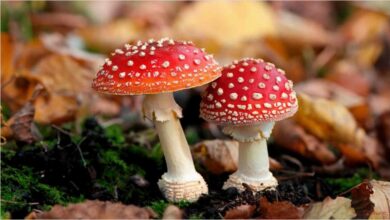
Fly Agaric Mushrooms – Description, Properties, and Uses

Fly agaric mushrooms are a type of mushroom known for their bright colors and toxicity. They belong to the Boletaceae family and are widely distributed throughout the world. Fly agarics have a distinctive appearance: their cap is red with white spots, and their stem is white with a ring. They grow in dark, damp forests, especially on soil rich in organic matter.
Article contents:
Fly agarics have a complex structure and consist of several parts. The cap is the upper part of the mushroom; it is convex and has a diameter of 5 to 20 cm. The stem is a vertical stalk attached to the cap. It can be 5 to 20 cm tall. On the stem of the fly agaric is a ring, which is a remnant of the lamellar layer that covered the cap when the mushroom was young. Under the cap are gills, which serve for the mushroom’s reproduction.
Toadstools are poisonous mushrooms, and eating them can lead to poisoning. They contain substances that have a toxic effect on the human body. When ingested, fly agaric mushrooms cause severe poisoning, which can manifest as vomiting, diarrhea, headaches, and other symptoms. Therefore, it is not recommended to pick and eat fly agaric mushrooms without specialized knowledge and experience in mushroom foraging.
Description of Fly Agaric
Appearance
Fly agarics are a type of mushroom belonging to the Amanita family. They have a distinctive shape and bright coloration, making them easily recognizable. The cap of a fly agaric is round or hemispherical and can reach a diameter of up to 15 centimeters. The cap color can vary from bright red to orange or yellow. White spots or grooves resembling flies are visible on the cap’s surface, hence the mushroom’s name.
Distribution and Habitat

Fly agarics are found in various parts of the world, but they are most common in the Northern Hemisphere. They prefer to grow in coniferous forests or on forest edges, where there is sufficient moisture and nutrients. These mushrooms are often seen in September and October, when autumn arrives.
Toxicity

Most species of fly agaric mushrooms are poisonous, so they are not recommended for consumption. They contain substances that can cause poisoning, manifesting as vomiting, headaches, hallucinations, and other unpleasant symptoms. However, in some cultures, fly agaric mushrooms are used for ritual purposes or to induce psychoactive effects.
Symbolism
Fly agarics hold special significance in the mythology and symbolism of certain cultures. They are often associated with magic, sorcery, and mythical creatures. In some cultures, fly agaric mushrooms are considered a symbol of good luck and abundance. Their bright colors and unusual appearance make them popular subjects for photographs and drawings.
Appearance of Fly Agaric
Fly agarics are poisonous mushrooms distinguished by their unique appearance. They have a characteristic shape of the cap, stem, and gills. The cap of a fly agaric can be round or bell-shaped, and its diameter can reach several centimeters. The cap of a fly agaric is covered with white or red spots against a red or yellow background.
The stem of the fly agaric is fairly slender and has a uniform color, which can range from white to red. It is often covered with white scales or a ring. The gills of the fly agaric are located on the underside of the cap and are usually white. They have a radial structure and are covered with spores, which can vary in shape and size.
The appearance of fly agarics is one of the main characteristics by which they can be identified. However, despite their beauty, it is important to remember that fly agarics are poisonous mushrooms. Eating them can cause serious poisoning, so it is not recommended to pick them without specialized knowledge and experience.
Distribution of Fly Agaric
Red Fly Agaric — these are mushrooms found all over the world. They occur in various climatic zones, including subtropical, temperate, and cold regions. Fly agarics can be found in forests as well as in meadows, parks, and gardens.
Generally, fly agarics prefer to grow in mixed forests with a sufficient number of deciduous and coniferous trees. They are often found under pine, spruce, and birch trees. Fly agarics can also be found in forest clearings and at the edges of the forest.
Fly agarics are known for their interactions with various species of plants and fungi. They can form mycorrhizae with trees, which means they establish a mutually beneficial symbiotic relationship with tree roots. In return, fly agarics receive nutrients from the trees and also help them absorb water and minerals from the soil.
Fly agarics are also important members of the ecosystem, as they serve as a food source for many animals. Some animals, such as moose and deer, eat fly agarics despite their toxicity. Other animals, such as foxes and raccoons, may use fly agarics as shelter.
- Fly agarics also play an important role in folk medicine. They contain various biologically active substances that can be used to treat various diseases.
- Some species of fly agarics, such as the spotted fly agaric, are used in ritual and shamanic practices in certain cultures.
- However, despite their widespread distribution, fly agarics are poisonous mushrooms. They contain toxins that can cause serious poisoning in humans and animals. Therefore, it is not recommended to collect and consume fly agarics without special processing.
Symbolism of Fly Agaric

Fly agarics are among the most famous and recognizable mushrooms in the world. They carry strong symbolic meaning and frequently appear in literature, art, and folklore.
1. Bright red-and-white spotted cap

One of the main characteristics of fly agaric mushrooms is their bright red-and-white spotted cap. This cap makes them very noticeable and eye-catching. The red color symbolizes strength and energy, while the white spots symbolize purity and innocence.
2. Connection to folk legends

Fly agarics are often mentioned in folklore and fairy tales. They are associated with magic, enchantment, and mystery. Some legends say that fly agarics are the guardians of portals between worlds and can help a person enter other dimensions.
3. Symbol of death and rebirth

In some cultures, fly agarics are associated with death and rebirth. Their toxicity makes them deadly, but when properly prepared, they can be used in medicine and folk magic for healing and purification. This symbolizes the transition from the old to the new, from death to life.
Danger of fly agarics

Fly agarics are poisonous mushrooms that can be dangerous to humans. They contain toxins capable of causing severe poisoning. The red fly agaric, the most poisonous member of this mushroom family, poses the greatest danger.
The toxins in fly agarics can cause serious harm to the human body. The main toxic substance in fly agarics is muscarine. It affects the central nervous system, causing convulsions, dizziness, nausea, and vomiting. In some cases, fly agaric poisoning can lead to loss of consciousness and even death.
Symptoms of fly agaric poisoning may appear within a few hours of consuming the mushrooms. They include headache, digestive upset, sweating, convulsions, and impaired coordination. If fly agaric poisoning is suspected, seek immediate medical attention.
Preventing toadstool poisoning involves the following precautions. First, you should avoid picking and eating unfamiliar mushrooms, especially those with bright colors. Second, it is recommended to consult experienced mushroom pickers or experts to obtain reliable information about which mushrooms are safe to pick and eat. It is also important to remember that mushrooms must be thoroughly cooked before consumption to destroy any potential toxins.